

Early childhood is the “golden opportunity” for vision development. Here’s why detecting and treating lazy eye (also known as amblyopia) early can make a lasting difference to children’s vision.
Imagine two children with lazy eye. One is diagnosed at age 4, while the other is only discovered at age 10. Both children may have similar vision problems, but their treatment plans could be different. Why? Because when it comes to lazy eye, it’s not just about how well children can see; it’s also about when their developing brain gets the help it needs. That is where “timing” becomes crucial!
Here’s something to blow your mind. Did you know that children aren’t actually born with fully developed vision? Although newborn babies can see from birth, their visual system is still developing. As they grow, their eyes and brain gradually learn to work together, helping them recognise details, judge distances, and develop clearer, more coordinated vision. This process is especially important during the first 6 to 8 years of life, when the brain has high visual plasticity.
Sounds complicated? Think of it this way. During these early years, a child’s brain is particularly adaptable. It constantly learns from the images received through the eyes, building the connections needed for good vision. This is often described as the sensitive period of visual development.
When one eye consistently sees a blurry image, or the eyes aren’t properly aligned, the brain may begin favouring the clearer eye and rely less on the other. Over time, this can interfere with normal visual development in the affected eye, potentially leading to amblyopia, commonly known as lazy eye. The longer this condition goes unresolved, the more challenging it is to improve vision in the affected eye. This is why early childhood presents such an important opportunity to detect and manage lazy eye.
Consider the two children from the beginning of the story. At age 4, the first child’s visual system is still highly adaptable. With appropriate treatment, the developing brain generally has greater potential to respond and improve vision in the affected eye.
For the second child, diagnosed at age 10, the situation may be different. As children grow older, the brain gradually becomes less adaptable. Treatment may still be effective, but improvement can sometimes take longer, and achieving similar vision in both eyes may become more challenging. Of course, every child’s condition is different. The outcome also depends on the severity and cause of amblyopia, previous treatment, and how consistently the recommended treatment is followed.
Does this mean lazy eye can no longer be treated after age 7? Not at all! Clinical studies show that older children and teenagers can still achieve meaningful improvements in vision with lazy eye treatment, especially if they haven’t been treated before.
The message is simple: Don’t wait until a child is older to seek help. The earlier lazy eye is detected, the higher the chance to achieve excellent visual outcomes.
Lazy eye is more than simply having one eye with poorer vision. When the brain becomes accustomed to relying on one eye, the weaker eye may continue to have reduced vision even when the eye is corrected with the correct prescription. This can affect more than just reading letters on an eye chart. Children with lazy eye may also struggle with depth perception (the ability to see in 3D) and judging speed or distances.
More importantly, if the condition remains untreated, reduced vision can persist into adulthood. Imagine growing up with one eye that never gets the chance to reach its full visual potential. This is why early detection matters. It is not just about improving eyesight during childhood but preserving visual abilities that last a lifetime.
Absolutely! In fact, this is one of the biggest reasons a comprehensive eye examination matters. A child with lazy eye may still run around happily, read books, watch television, and perform well in school. There may be no complaints about blurry vision, no obvious difficulties with daily activities, and seemingly no reason for concern.
But what if one eye has been doing most of the work all along?
When one eye provides much clearer vision than the other, the stronger eye may compensate during daily activities. As a result, children might not even realise that one eye is seeing less clearly. Young children may struggle to recognise or articulate vision differences, particularly when they have never experienced clear sight. Consequently, normal behaviour and an absence of complaints do not always indicate healthy visual development.
A comprehensive pediatric eye examination can assess each eye individually, identify unequal prescriptions, check eye alignment, and detect potential problems that may affect normal visual development. Sometimes, a problem that goes unnoticed in daily life can be discovered during a routine examination.
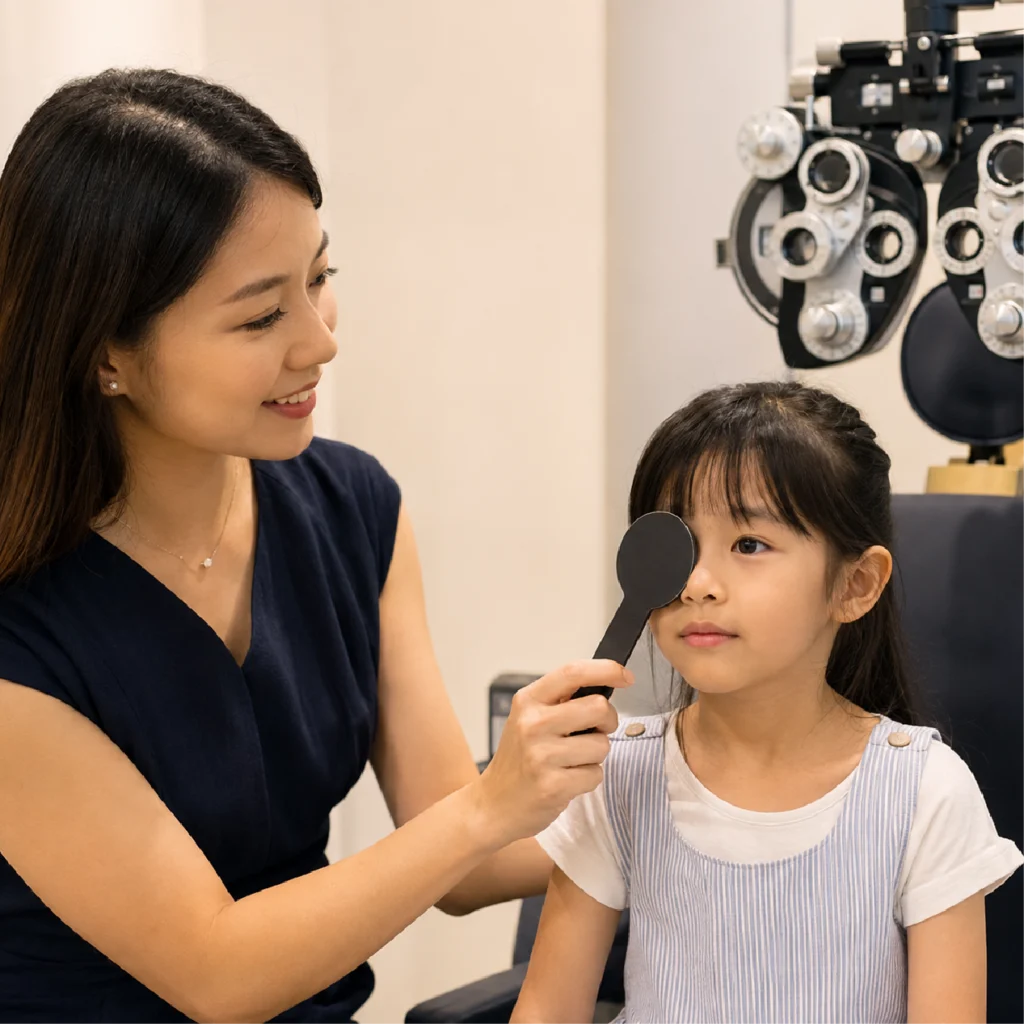
Early childhood is a critical window for visual development, and it doesn’t stay open forever. For the two children introduced earlier, the age at which amblyopia was detected could influence their treatment journeys. Although both may benefit from appropriate care, the child diagnosed earlier generally has a greater opportunity to achieve a favourable visual outcome.
The encouraging news is that lazy eye is treatable, particularly when detected early. Depending on the condition, treatment may involve prescription glasses, eye patching or, less commonly, atropine eye drops. Consistent treatment with regular follow-ups is also important in monitoring progress.
For children who have never had a comprehensive eye examination, the preschool period is an important time to ensure that visual development is progressing as expected. After all, children may not realise when one eye is seeing less clearly, and some vision problems may remain unnoticed for years.
An eye examination at the right time can make a difference that lasts a lifetime.